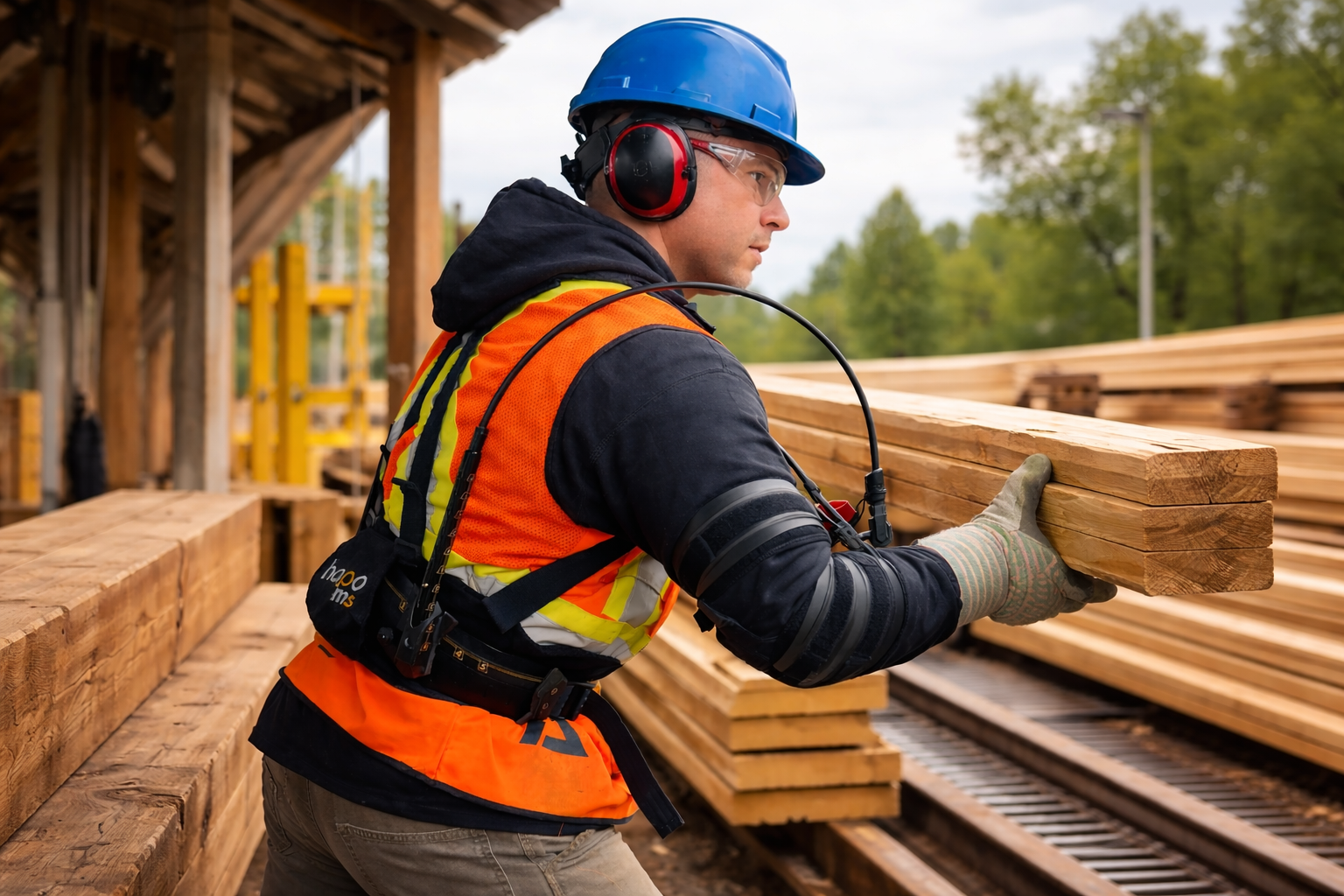
Exoskeletons in Canada:
the complete guide
for Canadian businesses
Musculoskeletal disorders cost Canadian businesses billions of dollars every year in workplace injuries and absenteeism. Exoskeletons have become the most concrete — and most accessible — answer to that problem.
If you manage a Canadian business or if you’re in charge of Heanth & Safety — in construction, logistics, manufacturing, agriculture, or healthcare — you’ve probably heard about exoskeletons. But between the marketing promises and the realities on the floor, it’s hard to know whether it’s the right investment for your team.
This very practical guide answers the real questions Canadian businesses ask before adopting an exoskeleton: which models exist, for which jobs, at what cost, and most importantly — does it actually work?
What exactly is a workplace exoskeleton?
An industrial exoskeleton is a wearable device that an employee puts on like protective equipment — except instead of guarding against external impact, it protects the body from itself by redistributing biomechanical loads across joints, muscles, and soft tissue.
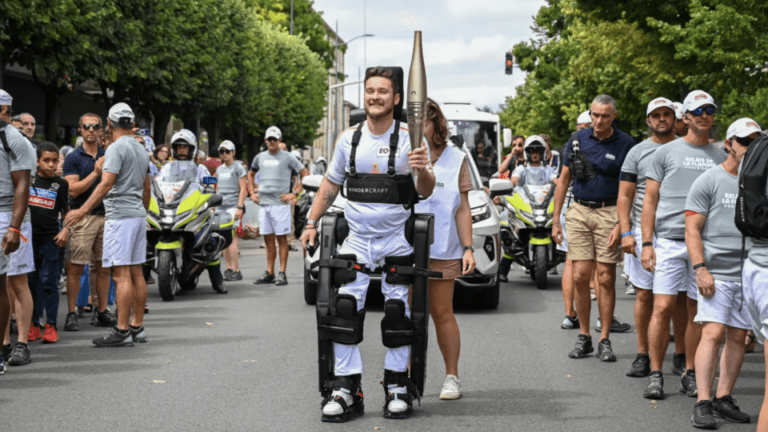
There are two main families. Passive exoskeletons work purely through springs and composite materials — no battery, no motor, no complex maintenance. Active exoskeletons incorporate an electric motor and sensors that amplify the worker’s movements, ideal for heavy lifting tasks.
“An exoskeleton doesn’t replace the worker or ask them to push harder. It allows them to do the same work, for longer, without breaking down.”
In Canada, exoskeleton adoption is still recent but accelerating fast. Several major manufacturing companies and medical teams have already made the move — and results documented by provincial occupational health bodies show significant drops in MSD-related incidents. Browse our full exoskeleton catalogue to see what’s available for your sector.
Which Canadian industries benefit most from exoskeletons?
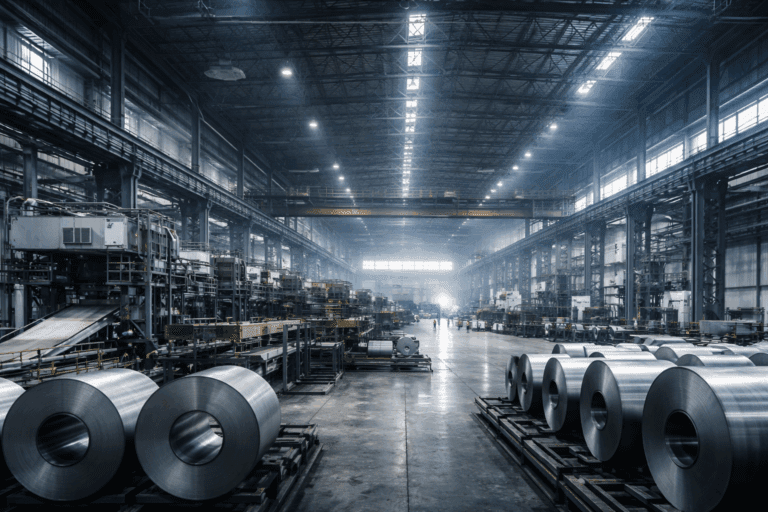
Manufacturing and assembly
Assembly line workers spend hours in constrained postures — arms overhead, back bent, head tilted. Shoulder and back exoskeletons are the most widely deployed here. Ford, among the earliest adopters, introduced upper-body exoskeletons on its North American assembly lines in 2018, with documented reductions in fatigue and injuries. The HAPO UP is the natural fit for this type of work.
Construction and auto mechanics
Working with arms raised to bolt, paint, or inspect overhead structures is one of the most frequent causes of shoulder MSD in Canada. An upper-limb support exoskeleton measurably reduces the effort placed on shoulders and elbows during repetitive tasks. The HAPO Front was designed precisely for these mid-height, arms-forward positions.
Logistics and warehousing
Heavy material handling and warehouse work rank among the occupations most exposed to lower-back MSD. Active exoskeletons like the HAPO Back and the SafeLift by VerveMotion — distributed exclusively across Canada by Umanistic — allow workers to lift substantial loads with motorized assistance, dramatically reducing lumbar strain.
Agriculture and landscaping
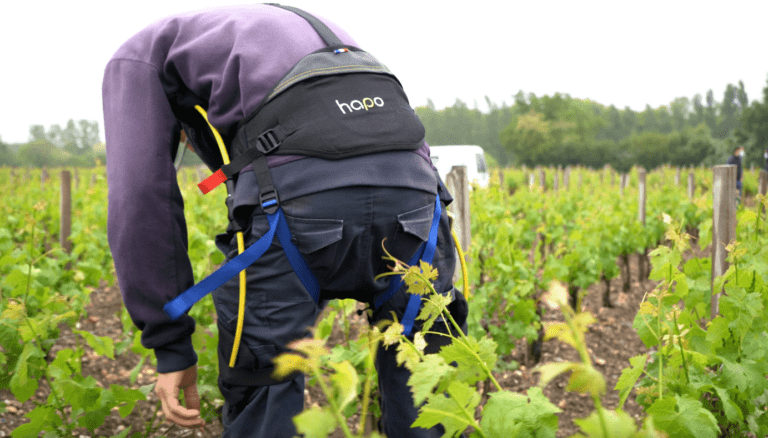
Trimming hedges, picking crops, working bent over the ground for hours — agricultural and landscaping trades stack every risk factor. A lightweight lumbar exoskeleton (under 2 kg) can radically change the comfort and career longevity of both seasonal and permanent workers. Read our deep-dive on exoskeletons in the agriculture sector.
Healthcare and surgery
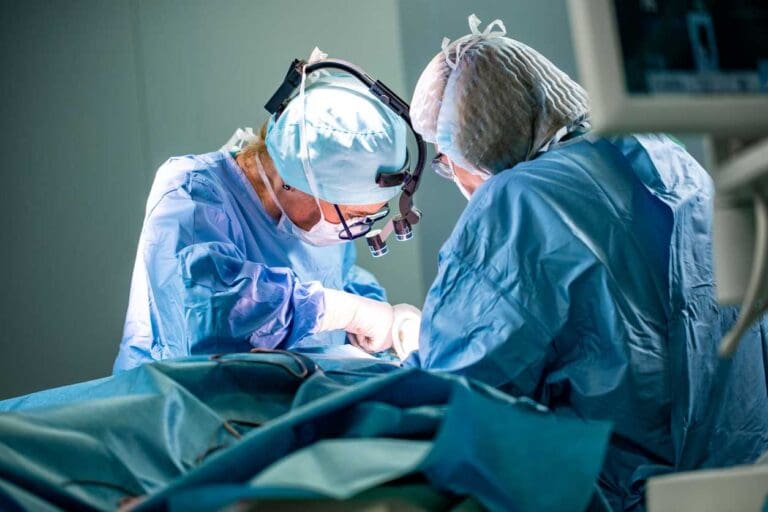
Surgeons, nurses, and medical technologists often work in prolonged static or bent positions. Several Canadian surgeons already wear exoskeletons during procedures to reduce back pain and improve stability — and therefore precision. Learn more about exoskeletons for physicians and surgeons.
HAPO Back
The most widely deployed lumbar exoskeleton in Canada. Passive, lightweight, one size fits all — designed for warehousing, manufacturing, and construction.
Passive · 1.3 kg View product →HAPO Front
Protects arms and shoulders for repetitive mid-height tasks. Exceptionally light at 1.3 kg with full freedom of movement.
Passive · 1.3 kg View product →HAPO Neck
Built for overhead tasks and head-tilted postures. The go-to for surgeons, auto mechanics, and painters working above shoulder height.
Passive · 300 g View product →Crimson Fit
Probably the most versatile back exoskeleton available in Canada. Fast to adopt, immediately comfortable for teams across most sectors.
Passive · One size View product →Spineband
Swedish design for neck pain relief during forward head posture tasks. Ideal for detailed assembly work and prolonged screen-adjacent positions.
Passive · Ultra-light View product →SafeLift — VerveMotion
Active exoskeleton with motor. 240 N of lift assistance at under 3 kg. Real-time data via integrated sensors — the 3-in-1 solution for warehousing.
Active · Motorized View product →How do you evaluate the return on investment?
The question that comes up in every single consultation: “How much does it cost, and how quickly will we break even?”
The honest answer: it depends on your sector, your turnover rate, and how many workers’ compensation claims you’re currently managing. But here’s what we typically see with our Canadian clients.
- Reduced workers’ compensation claims — a single avoided claim can cover the cost of ten or more exoskeletons
- Lower absenteeism — MSDs are the leading cause of prolonged absence in Canadian manufacturing and logistics companies
- Reduced staff turnover — workers whose bodies are protected stay in their roles longer, reducing costly retraining cycles
In practice, our clients see a return on investment within 12 to 24 months for passive deployments, and sometimes under 12 months in high-incident sectors like heavy logistics. Learn more about the business advantages of exoskeletons.
Umanistic: Canada’s exoskeleton integrator
Umanistic is Canada’s only exoskeleton integrator — holding the licences to sell, deploy, and support our full product range across the country. The distinction matters: a distributor sells you a product. An integrator ensures that product genuinely fits your operational reality — your workstations, your teams, your processes. Our model rests on three stages.
The first is a posture analysis consultation — we use an AI-powered application to assess joint angles and objectively evaluate risk levels by workstation, before any equipment is selected. The second is a supervised trial in real conditions: your own employees, at their own workstations, with on-site accompaniment. The third is full team training and deployment, with regular follow-ups to ensure lasting adoption — not a pilot that fades out after six weeks.
This process eliminates the most common and costly mistakes: choosing the wrong model, fitting equipment incorrectly, or abandoning the initiative for lack of proper support. See who we are and how we work.
Questions Canadian businesses always ask
Can all employees wear an exoskeleton?
In the vast majority of cases, yes. Approximately 90% of body types are compatible with the passive exoskeleton models we carry in Canada. Some models are one-size-fits-all with multiple adjustment points; others come in specific sizes. Very short or very tall individuals may have difficulty with certain passive models — something we identify during the supervised trial before committing to a full deployment.
Do exoskeletons weaken muscles over time?
This is the most frequently asked question — and a completely legitimate one. No study has ever demonstrated muscle atrophy linked to workplace exoskeleton use. The reason is straightforward: exoskeletons are worn only during high-risk work phases, not continuously. Muscles continue to be used normally the rest of the time. This is assistance, not replacement.
Is funding available for exoskeletons in Canada?
Several provincial prevention programs — including CNESST in Quebec and equivalent bodies in other provinces — offer subsidies or partial reimbursements for MSD prevention equipment. Exoskeletons may qualify. We guide you through the application process as part of our initial consultation. Read more about the growing incidence of MSDs in Canada and the case for prevention investment.
Can we try exoskeletons before buying? Do you offer rentals?
Yes. Our supervised trial program lets your team test the right models directly on your worksites before any purchase commitment. This is a core part of our integration process — not an optional extra. Contact us to schedule a trial for your facility.
A distributor sells. An integrator deploys. The difference is everything that happens between the purchase order and real adoption by your teams:
- Risk posture analysis — AI-powered, before a single model is selected
- Personalized selection — the right exoskeleton for the right workstation
- Supervised on-site trial — with your employees, at their actual posts
- Training and onboarding — for lasting adoption, not a forgotten pilot project
- Follow-up and measurement — to document ROI and adjust as needed
Ready to protect your team?
As Canada’s exoskeleton integrator, we don’t just sell equipment — we guide you from analysis to adoption. No-commitment consultation to get started.
Book a free consultationUmanistic is Canada’s only exoskeleton integrator — from posture analysis to team training, including supervised on-site trials at your workstations. We operate across Canada with the licences to distribute and deploy our full product range.
Share post